Cute Crab Embroidery Design
A Playful, Professional Fit for Small Business Branding
As an embroidery designer who’s developed hundreds of commercial designs for cafes, boutiques, bakeries, pet brands, and creative studios, my first impression of the Cute Crab Embroidery Design is immediate and positive: it delivers a friendly, approachable ocean vibe without sacrificing polish. The “kawaii” aesthetic—soft curves, expressive eyes, and simplified anatomy—makes it instantly charming, yet its clean lines and balanced proportions signal professional execution. It doesn’t read as childish or overly cutesy; instead, it lands as warm, memorable, and confidently on-brand for businesses that want to stand out with personality—not just pattern.
Real-World Performance Across Merchandise Types
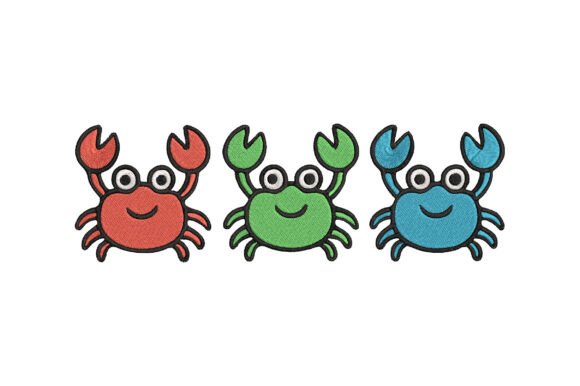
The Cute Crab Embroidery Design shines in contexts where brand warmth and visual clarity matter most. For small business merch, it works exceptionally well as an embroidered patch—ideal for attaching to tote bags, aprons, denim jackets, or staff uniforms. Its three color variations (red, green, and blue) offer smart flexibility: match one to your café’s coral accent wall, another to your florist’s seasonal palette, or rotate them across limited-edition product drops. As a chest logo on custom apparel, it reads clearly at 2.5–3 inches wide—large enough to convey detail, small enough to avoid overwhelming a shirt front or cap embroidery placement.
On caps, the design holds up beautifully when centered on the front panel—its symmetrical shape and bold outlines prevent distortion over curved surfaces. For tote bag design or apron embroidery, the crab’s compact silhouette ensures strong legibility even after repeated washing and daily wear. And because it’s part of a bundle, you can layer the red, green, and blue versions across different product lines (e.g., red for summer event merch, blue for coastal-themed packaging accents), reinforcing visual consistency while keeping offerings fresh.
Where to Use It Thoughtfully
Like any machine embroidery design, the Cute Crab Embroidery Design benefits from intentional application. Avoid scaling it below 1.75 inches for embroidered patches—tiny claws and eye details may lose definition, especially on textured fabric like canvas or twill. On dark uniforms or navy caps, verify thread color contrast: the red version pops strongly, but the green or blue may need a white underlay or slightly brighter thread selection for optimal visibility. Also, test stitch density on lightweight fabrics—while the design appears playful, dense fill areas could stiffen delicate materials unless paired with appropriate stabilizer.
Curved surfaces (like cap fronts or rounded tote handles) require careful hooping and digitizing awareness—though the kawaii style’s forgiving outlines help minimize stretching issues. If using the Cute Crab Embroidery Design for product packaging accents (e.g., stitched tags on handmade soap or candles), confirm that the smallest version maintains charm without blurring into abstraction. Always inspect spacing between elements—especially between claws and body—to ensure no unintended thread nesting occurs during high-speed commercial embroidery runs.
How It Strengthens Brand Identity and Customer Connection
For small business owners, every stitch is a brand touchpoint—and the Cute Crab Embroidery Design supports trust and recognition in subtle but powerful ways. Its consistent, cheerful presence across aprons, staff caps, and customer totes tells a cohesive story: this is a business that values craft, care, and character. Unlike generic clipart or overused icons, this design feels intentional, handmade, and human-scaled—key for Etsy sellers and local shops competing on authenticity.
Customers notice the difference. A bakery with crab-embroidered aprons signals creativity and attention to detail. A pet brand using the blue crab on leashes or collars adds lighthearted memorability without undermining professionalism. Even in digital spaces, the Cute Crab Embroidery Design elevates printable mockups—clients respond more enthusiastically to proposals featuring real-world embroidery samples than flat vector previews. That visual consistency builds recognition across platforms, turning merchandise into quiet brand ambassadors.
Practical Designer Notes Before You Stitch
Before launching production, run these checks:
- Test in black and white first—verify contrast and readability without color distraction.
- Check small patch size performance—hoop and stitch a 1.75-inch version on your target fabric to assess claw clarity and stitch smoothness.
- Review thread color contrast, especially on dark or heathered fabrics—consider adding a white underlay if needed.
- Inspect spacing and jump stitches—tight areas between claws and body should be clean, not crowded.
- Confirm hoop size compatibility with your commercial embroidery machines—some kawaii-style fills require stable, centered hooping.
- Test on real fabric, not just stabilizer—canvas, denim, and cotton poplin behave differently under needle stress.
- Use proper stabilizer: medium-weight cutaway for structured items (caps, patches), tear-away for lighter apparel.
- Create a physical mockup for client approval—stitched samples build confidence faster than digital files alone.
- Compare beside other design assets—does the crab complement your logo, typography, and existing embroidery file library?
- Confirm commercial licensing before bulk production—this is essential for small business merch, custom apparel, and resale items.
The Cute Crab Embroidery Design isn’t just a seasonal flourish—it’s a versatile, scalable asset for Summer-themed branding and year-round identity building. Whether you’re stitching for a seaside boutique, a vibrant florist, or a playful pet brand, it bridges fun and function with thoughtful design integrity. When paired with smart embroidery practice and brand-aligned application, it transforms everyday items into distinctive, emotionally resonant pieces of small business merch.